


Artificial IntelligenceDigital TransformationAI and JosCareer Development
How AI Is Changing the Future of Work and Career Opportunities
Explore how AI is transforming the workplace, changing jobs, creating new career opportunities, and shaping the skills needed to succeed in the future of work.
2026-11-05
5 min read
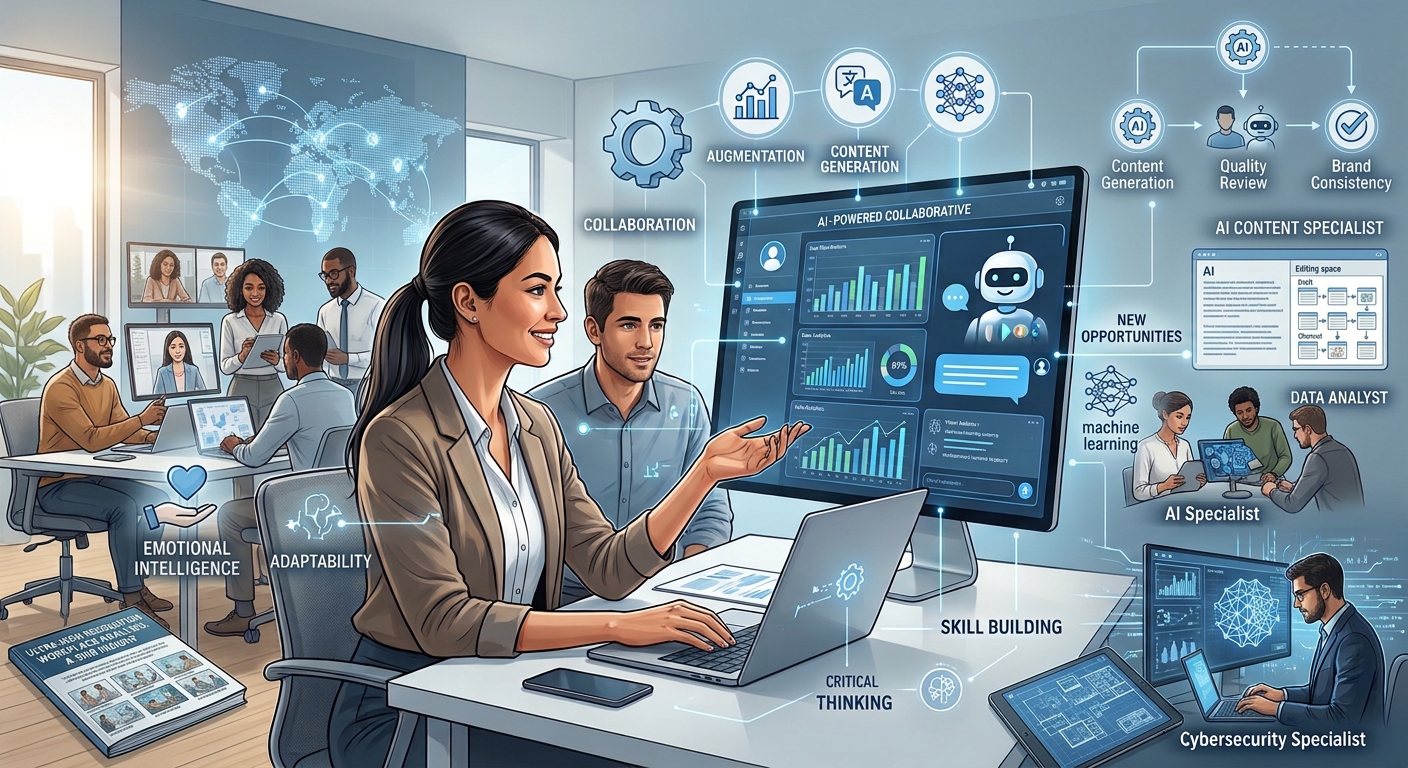
Artificial Intelligence (AI) is changing the way people live, learn, and work. From chatbots that answer customer questions to tools that help create designs, write content, and analyze data, AI is becoming a part of everyday life. It is also changing how businesses operate and how people build their careers.
The relationship between AI and the future of work is becoming an important topic for employees, students, job seekers, and business owners. Many people wonder whether AI will take away their jobs or create new career opportunities. The truth is that AI is doing both. It can automate some tasks, change existing jobs, and create new types of work.
As technology continues to grow, understanding AI is becoming more important than ever.
What Is Artificial Intelligence?
Artificial Intelligence, commonly known as AI, is technology that allows computers and machines to perform tasks that usually require human intelligence.
These tasks include learning, solving problems, understanding language, recognizing images, and making predictions.
For example, when you use ChatGPT to write an email, Google Maps to find the best route, or a chatbot to get customer support, you are using AI.
Today, businesses use AI to save time, improve productivity, reduce manual work, and make better decisions. As a result, artificial intelligence in the workplace is becoming more common across different industries.
How AI Is Changing the Future of Work
AI is not just another technology trend. It is changing how people complete tasks, communicate, and work with others.
Here are some major ways AI is changing the future of work.
1. Automating Repetitive Tasks
One of the biggest changes brought by AI is automation.
Many jobs include repetitive tasks such as entering data, organizing files, answering common questions, and preparing basic reports. AI tools can now complete many of these tasks faster.
For example, businesses can use AI chatbots to answer common customer questions instead of having employees respond to every message manually.
This allows employees to spend more time on important tasks that need human thinking and decision-making.
2. Improving Workplace Productivity
AI helps employees complete tasks more quickly and efficiently.
For example:
- Writers can use AI tools to brainstorm ideas and organize content.
- Designers can use AI to explore creative concepts.
- Developers can use AI coding assistants to find errors and understand code.
- Marketing teams can use AI to study customer behavior and improve campaigns.
- Businesses can use AI to analyze information and prepare reports.
These tools support employees by reducing the time spent on routine work.
However, AI-generated results still need human review to make sure they are correct, useful, and suitable for the task.
3. Changing How Businesses Hire Employees
AI is also changing the recruitment process.
Many companies now use AI-powered tools to organize job applications, match candidates with job requirements, and schedule interviews.
For example, recruitment software can help HR teams review large numbers of applications more quickly.
However, human decision-making is still important. Employers need to consider a candidate's personality, communication skills, experience, and ability to work with others.
AI can support recruitment, but it should not replace fair and careful hiring decisions.
4. Supporting Remote and Flexible Work
AI is making remote work easier for many businesses.
Employees can use AI-powered tools for meeting summaries, task management, language translation, scheduling, and communication.
For example, a team working from different countries can use AI translation tools to understand messages and communicate more easily.
These tools help teams save time and work together even when they are not in the same location.
5. Improving Decision-Making
Businesses collect a lot of information about customers, sales, marketing, and daily operations. Understanding all this information can take time.
AI tools can study large amounts of data and identify patterns that may be difficult for people to notice.
For example, a business can use AI to understand customer preferences, predict product demand, and improve its marketing strategy.
AI provides useful information, but business leaders still need to use their experience and judgment before making important decisions.
The Impact of AI on Jobs: Which Jobs Are Changing?
The impact of AI on jobs is different across industries. Some tasks can be automated, while others still require human creativity, communication, and problem-solving.
AI is more likely to change specific tasks within many jobs rather than completely replace every role.
Here are some examples:
Jobs That May Be Affected by AI
1. Data Entry and Administrative Work
AI can organize information, enter data, and prepare basic documents. This may reduce the need for some manual administrative tasks.
2. Customer Support
AI chatbots can answer common questions and provide basic support. However, complex customer problems still need human assistance.
3. Content Writing
AI can help generate ideas, outlines, and basic drafts. Human writers are still important for research, storytelling, originality, and fact-checking.
4. Graphic Design
AI tools can generate images, suggest layouts, and create design ideas. However, human designers are needed to understand client requirements, develop brand identities, and make creative decisions.
5. Accounting and Finance
AI can help organize financial records, process invoices, and identify unusual transactions. Professionals are still needed for financial planning, analysis, and important decisions.
The important thing to understand is that AI may change how these jobs are performed, but it does not automatically make human workers unnecessary.
New AI Career Opportunities
While AI is changing some existing jobs, it is also creating new career opportunities.
As businesses adopt AI technology, they need people who can develop, manage, use, and improve these systems.
Here are some career opportunities growing alongside AI.
1. AI and Machine Learning Engineer
AI engineers develop systems that can learn from data and perform intelligent tasks. They work on AI applications, machine learning models, and automation systems.
2. Data Analyst
Data analysts study information to help businesses understand trends and make better decisions. AI tools can support their work, but people are still needed to interpret results.
3. AI Specialist
AI specialists help businesses understand and use AI tools. They identify tasks that can be improved through AI and help organizations use these technologies effectively.
4. AI Content Specialist
AI content specialists use AI tools to support content research, planning, and creation. They also review content to maintain quality, accuracy, and brand consistency.
5. Cybersecurity Specialist
As businesses depend more on digital systems, protecting information becomes increasingly important. Cybersecurity professionals help identify risks, prevent attacks, and protect sensitive data.
6. AI Automation Consultant
AI automation consultants help businesses find repetitive tasks that can be automated. They recommend suitable tools and create workflows that save time and improve productivity.
These examples show that AI is not only changing existing careers but also creating new areas of work.
Skills Needed in the AI Era
As AI becomes more common, employees need to develop new skills to remain competitive.
Learning how to use AI is important, but technical knowledge alone is not enough. People also need skills that help them work effectively with technology and other people.
Here are some important skills needed in the AI era.
1. Digital and Technical Skills
Basic knowledge of computers, digital tools, and AI platforms is becoming important in many industries.
People do not need to become programmers to use AI. However, understanding how digital tools work can make everyday tasks easier.
2. Critical Thinking
AI can provide answers and suggestions, but those answers are not always correct.
Critical thinking helps people check information, identify mistakes, compare ideas, and make better decisions.
3. Creativity
AI can generate ideas, images, and written content. However, human creativity helps businesses develop unique concepts, understand emotions, and connect with customers.
4. Communication Skills
Good communication helps people explain ideas, understand others, and work effectively in teams.
Even in an AI-powered workplace, businesses need people who can communicate clearly with customers, employees, and partners.
5. Problem-Solving Skills
Every business faces challenges. People who can understand problems and find practical solutions will remain valuable.
6. Adaptability and Continuous Learning
Technology changes quickly. People who are willing to learn new tools and improve their skills will be better prepared for future changes.
Why Human Skills Still Matter in the Workplace?
Even as AI becomes more advanced, human skills in the workplace remain extremely important.
AI can process information, generate responses, and automate tasks. However, it does not replace every quality that makes people valuable at work.
Some important human skills include:
- Emotional intelligence: Understanding people's feelings and responding with care.
- Leadership: Guiding teams and helping people work toward common goals.
- Creativity: Developing original ideas and finding new ways to solve problems.
- Communication: Building relationships and sharing ideas clearly.
- Decision-making: Considering different situations and making responsible choices.
- Teamwork: Working with others and respecting different opinions.
These skills help people do work that requires understanding, trust, and human connection.
The future workplace will likely depend on a combination of human abilities and AI technology.
How Students and Professionals Can Prepare for the Future
Preparing for the future does not mean learning every new AI tool. It means developing the right skills and understanding how technology can support your career.
Here are some practical steps:
1. Learn How AI Tools Work
Start exploring AI tools such as ChatGPT, Gemini, and other platforms related to your field. Learn what they can do and where their limitations are.
2. Improve Your Existing Skills
Do not depend entirely on AI. Continue improving your knowledge, creativity, communication, and problem-solving abilities.
3. Explore New Career Opportunities
Research careers related to AI, data analysis, automation, cybersecurity, and digital marketing.
4. Build Practical Experience
Try using AI tools in real projects. For example, students can use AI to support research, professionals can improve their workflows, and business owners can explore simple automation.
5. Keep Learning
Take online courses, attend workshops, read industry blogs, and stay updated with new technology.
The people who are willing to learn and adapt will be better prepared for the changing world of work.
Will AI Replace Humans or Work Alongside Them?
This is one of the most common questions about AI and the future of work.
AI will replace or reduce the need for some tasks, especially those that are repetitive and follow clear instructions. However, many jobs require human judgment, creativity, emotional understanding, and personal communication.
Instead of thinking only about AI replacing humans, it is better to understand how people can work alongside AI.
For example, a graphic designer can use AI to explore design ideas but still make the final creative decisions. A marketer can use AI to study customer data but still develop the overall marketing strategy.
The goal should be to use AI as a helpful tool rather than depend on it for everything.
Businesses and employees who learn to combine human abilities with AI technology can find new ways to work more effectively.
Conclusion
AI is changing the way people work, how businesses operate, and what skills employers need. While automation may affect certain tasks and existing jobs, it is also creating new career opportunities across different industries.
Understanding AI and the future of work is important for anyone who wants to stay prepared for the changes ahead.
The best way to prepare is to learn new technologies, improve existing skills, and focus on human abilities such as creativity, communication, critical thinking, and problem-solving.
AI is a powerful tool, but people still play an important role in making decisions, building relationships, and creating meaningful work.
The future is not simply about competing with AI. It is about learning how to work with it.